Surviving On Snippets Of Hope

I know people who don’t consume the news anymore. Others avidly click, swipe, and share and demand the shares be shared and that donations be made.

A sense of needing to ‘do something’ beats like a heart behind our screens.

Some say the carnage and its causes are complex. Others claim it couldn’t be simpler. Meanwhile, powerful, malevolent toddlers masquerading as leaders extinguish lives with their belligerent tantrums. This kind of hellish tit for tat has been going on all over the planet for aeons. There’s nothing new about our news.

The atrocities we were clicking and swiping and enthusiastically sharing and donating to a year or two ago, are far from over.  This trauma has not stopped. It’s just not as fresh as what we are fed from further south right now.

While my bipolar disorder sleeps, I choose to neither soak myself in headlines nor bury my head in our (increasingly hot) sand.

I have always struggled to understand warring over a homeland, because (regardless of my genetics, birthplace, or heritage) I don’t identify as belonging to a country or a people. I was taught to be a chameleon, a grateful visitor wherever I go. It has been drilled into the DNA of my family who moved around a lot, who has flight in its history, whose ancestors have done their best not to be in the wrong place at the wrong time.

I don’t believe humanity has quite enough humanity to ever achieve world peace. If we had the capacity to resolve conflict without collateral civilian casualties, we’d have done so a long time ago.

Our individual lack of control over global catastrophes and atrocities can feel depressing. But we can each control how we react to our feelings. Providing we are not experiencing a severe episode of clinical depression, we can feed our sense of hope by turning a microscope on our own lives and surroundings.

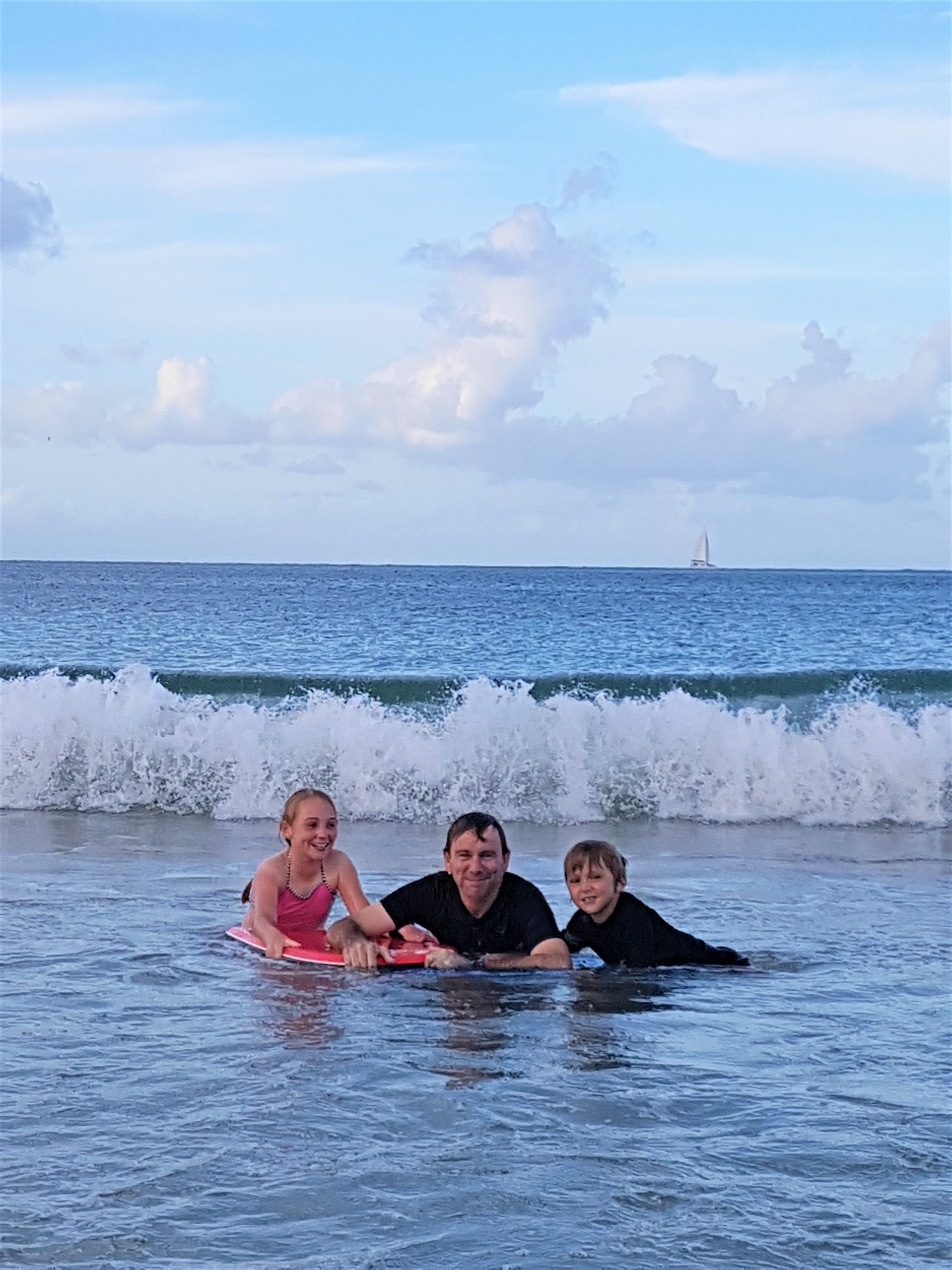
Good stories play out near us all the time. I witnessed one on holidays at the beach recently:

A not so gentle day. Dumping waves boiled the water. One after the other. If you got caught up in one of those you became an ingredient in a soup of flailing limbs. A bit closer to the shore we laughed and played in the sea foam bubble bath, eyes always on the incoming, legs resisting the drag out into the angry ocean.

Then to my right a little girl, five or six, began to cry. The wash after a wave swallowed her and spat her back up like an acorn. Spluttering, she looked wildly about. I assumed the woman near her was her grandmother. She scooped up the crying girl and pointed to some other adults nearby. The girl shook her head, sobbed red faced, hair plastered to her head.  I just caught the older woman’s words above the rush of water.

‘Can you point to your mummy or daddy darling?’

The girl was crying too hard for speech, too hard to point. This was not her grandmother.

Yet she positioned the girl on one wide hip and purposefully strode away from danger. Finally, where the waves petered out onto the sand, the girl’s father appeared, and a narrative that could have played out so badly, ended well.

While the brutality of the news can suck the happiness out of our heads, good things still exist. And they don’t need to be stories. Simple snippets suffice:

Taking refuge from a storm in a second hand book shop.

 Sleeping cats.

A tidy bedroom and a good book.

The sound of cicadas.

Wildlife visitors.

Converting ingredients into a meal.

Having a kitchen to cook in.

A warm hand to hold walking in the summer breeze.

A rainbow, thunder, and lightning occupying the sky all at once.

The clink of ice cubes against a condensation beaded glass, and the first sip.

Clean pyjamas after an evening shower.

Children growing into themselves.

Free will and choice…

When I disengage from my screens for long enough to look around me, snippets appear everywhere.

I have at times been guilty of outrage in response to what my screens feed me.

But, for me, outrage on its own achieves little. It is hot air shouted into a furnace. And it is a luxury I can’t afford or sustain, because ongoing outrage can convert into powerful fuel for a bipolar episode.

On the other hand, deciding to tend the happiness in my own backyard builds the strength to do meaningful things for myself and the wider world.

PS: If you are clinically mentally unwell, then the suggestions in this post to focus on the positives around you apply only if you are well enough to do so. Symptoms of severe mental illness, especially clinical depression, can make it impossible to focus on the positives without more targeted treatments, such as psychological or medical therapies.

For me, a sign that I need more support than the power of positive thought is when I find it impossible to focus on the positive, and guilt and negative self-talk set in, because I’ve failed to appreciate the positive.

Lastly, if I were currently experiencing a bipolar episode I would not consume any news, and would focus solely on recovery.

You may also like:

Gentle Shoots Of Hope

Deciding To Hope

Challenging Family Bigotry

I don’t usually pour my energy into the sinkhole that is responding to objectionable social media posts, even when scratching the itchy impulse to sling a vomit emoji or a WATF into the comments section of someone I don’t know, feels irresistible.

But it’s trickier when you not only know but have real life connections and interactions with the authors, re-posters, and likers of problematic posts. To clarify, when I say ‘objectionable’ and ‘problematic’, I mean homophobic, transphobic, racist, and bigoted posts masquerading as ‘I am entitled to my opinion’.

The first time one of these popped up on my screen from someone familiar to me in real life I reflected through my shock and anger. Perhaps it was ill considered? Posted in haste? I decided to let it go.

The problem is the first time was not the last. Over a couple of years there have been enough to show they are more likely to spring from strongly held, hostile beliefs rather than accidental misjudgements.

How then do I react?

Although not extremely frequent, each fresh post is another pebble in the shoe of my conscience, and prompts a quote from a speech given by Chief of the Australian Army, Lieutenant-General David Morrison to roll around in my thoughts:

‘The standard you walk past is the standard you accept.’

It has become impossible for me to just keep walking.

Silence feels unacceptable and challenging these Facebook posts in the comments section would just pour oil on a bin fire I don’t want to give oxygen to. So, this is where I am at:

I don’t believe the people I know who engage in this content are bad people.

It just seems they might be struggling to see beyond their own cramped worldview and demands. They seem to feel threatened and instead of learning to open themselves up to explore their uncomfortable feelings, they clamp down and slam shut the door to curious compassion.

We all love our comfort zones, but when our comfort comes at the expense of the health, safety, and wellbeing of others we need to question whether it is worth it.

I am not going to quote specific content I’ve encountered. But I will probe and push back on one troubling often cited reason for the defensiveness in many of these posts.

The authors claim they don’t want to be made to feel responsible for ‘things’ that happened at the time the British invaded Australia. The lack of awareness that these ‘things’ are still happening and that ‘things’ is a slimy euphemism for ‘atrocities’ leaves me lost… and unhelpfully debating whether to reach for something heavy to throw or a bucket to vomit into.

Then there is the point that this approach to historical events misses completely:

No one is directly responsible for their ancestors’ actions.

But whether we had responsible ancestors or not we can all reflect on the impact those ancestors’ actions had, and still have, on others today. It is the only way to move forward with awareness instead of entitlement.

None of us live in a vacuum. We all have effects on each other. Turning away on the grounds that we weren’t around when something bad happened in history, guarantees bad things continue to happen.

Between the ages of six and thirteen I grew up in Germany, where high school students had excursions to former Nazi concentration camp sites. This was not to make the students whose forebears were responsible for the horrors perpetrated in those camps ‘feel responsible’ but to educate all students about this horrendous period of their country’s history.

It was to prevent the next generations from walking into their future with blinkers on about their past.

Those who have only ever lived in one community might have to work harder at gaining a wider world perspective. It might feel uncomfortable to slip on glasses and see beyond the brand of fierce, Australian, colonial, patriotism that has inflicted and continues to inflict so much trauma on First Nations people and their countries.

When I dig beneath my initial outrage and frustration over these social media posts, I am left…frustrated by my current indecision and the frayed end of this post. I like clean excisions and neat stitches.

I would prefer not to create family rifts but am also not conflict avoidant enough to rule out cutting people from my life whose values and world view feel so incompatible with mine.

Would I make this decision based on social media posts alone? Probably not. I am cautiously open to respectful conversations with the people involved but unwilling to engage in meaningless conflict for the sake of it.

As for future social gatherings, I think I may struggle to just play in the topsoil of pleasantries when I can’t unsee the sinister seeds threatening to sprout from below the surface.

You may also like to read:

Honoured, Grateful, And Guilty: A Tangled Family History

Honoured, Grateful, And Guilty: A Tangled Family History

image tangled family history

The strands in my children’s heritage are tightly intertwined, multicultural, and impossible to untwist from each other. History labels their predecessors perpetrators and victims, depending on which of their ancestral branches you examine.

A photograph of my maternal great grandmother hangs in my hallway. She looks serious. In mid 1920s Warsaw. Dark haired and dark eyed. My grandmother, aged three or four, stands next to her in a light dress, their arms linked.

My maternal great grandmother was too attached to her country. Fatally so. To me, she is a cautionary tale of the danger of fastening yourself too tightly to one part of the world.

But I only know fragments of her story:

My grandmother (in the light dress) was about nine or ten when she emigrated from the Jewish ghetto in Warsaw to Australia with her parents.

Shortly after their arrival, my great grandmother looked around at the vast, bright country she found herself in and decided it was too foreign for her. She pressed some coins into my grandmother’s hand and sailed back.

To Warsaw.

In doing so she inflicted a lifetime of trauma on my grandmother and signed her own death warrant. Her life was erased by the Holocaust that ripped through the country she chose over her daughter. A daughter who would be orphaned in the vast, bright country at twelve, when her father died just a couple of years later.

My parents’ wedding photograph also hangs in my hallway. Taken in Duesseldorf, 1971. My mother’s dark hair. Dark eyes. My father’s white blond hair. Blue eyes.

I was born in Germany, lived in Saudi Arabia from ages one to five and returned to Germany just before my sixth birthday, in time to start school.

Many German born children of my generation were infused with guilt. We read When Hitler Stole Pink Rabbit by Judith Kerr in primary school. The older grades took school excursions to former Nazi concentration camp sites. This shameful chapter in Germany’s history was rightly not denied or underplayed.

And the whole world pointed its finger at us. At least it felt that way when I moved to Brisbane with my family aged thirteen.

Almost as soon as I started school, a chunky, pimply, blond boy in my year began greeting me with a Nazi salute and yelling ‘Heil Hitler!’ every time he saw me. The other kids stared as though I were personally responsible for Hitler’s actions. Each time it happened I was swallowed by a boiling pit of mortification and anger.

I already owned my German guilt. Guilt with a twist. The country I’d been born in, whose language I spoke flawlessly, that was home to all of my friends, whose seasons, landscapes, and culture I loved, had in recent history been responsible for the genocide of my mother’s family’s people.

My guilt and that knowledge had already curdled uncomfortably inside me, before that boy began hurling the only, and highly offensive, reference point he had for German people, at me.

My maternal grandfather’s Jewish roots can be traced back to 16th Century Portugal. It is one half of where my children’s dark eyes come from. Their high foreheads and cheekbones travelled from Latvia and Germany via my father. The shape of their chins can be traced back to English ancestors from my husband’s family.

My children are both first and seventh generation white Australians.

It is messy alright.

My ancestors didn’t happen to be in Australia when white people invaded and began inflicting trauma that is still ongoing on the First Nations People. But my husband’s predecessors landed here as missionaries ten years after the first fleet.

Does any good ever come from entering a foreign country aiming to convert its peoples to a belief system not their own?

I don’t believe so. No matter what the intent.

And no matter how much I love the descendants of those missionaries, my guilt echoes around that family history. It feels similar to the guilt I felt as a German child of the early eighties.

Yet, guilt on its own achieves nothing unless it pushes us towards acknowledgement and action.

Over the last weeks I have researched and asked advice from people with Aboriginal or Torres Strait Islander heritage on wording an acknowledgement of Country and its First Nation Peoples to include in my book. I am so grateful for their time and knowledge.

I am still working on the exact wording. But I plan to include this (slightly reworded) content from an acknowledgement by the Climate Justice Union:

‘I appreciate I have much to learn about the oldest continuous living culture. I am listening, seeing, and learning.’

We are all capable of listening, seeing, and learning – in some form.

And when my children look at their own hallway photographs one day, I hope they will be proud of their incredible hybrid vigour, know where they came from, but also that they are honoured and should be thankful to travel safely over Aboriginal and Torres Strait Islander lands.

You can find an excerpt of my book, which is due to be published this year (Covid permitting) here:  Book  and the story of  the book’s journey here: Accepted: Crumbs To Canary Wharf