The Postpartum Psychosis Circus Is In Town

It’s in the news again. Postpartum psychosis (ppp) with a dreadful outcome. I feel caught in a murky riptide of misinformation and hot takes.

I experienced my first episode of ppp 20 years ago. The second just over 16 years ago. I began writing and speaking about it 14 years ago. I’d earnestly hoped writing about my experience would help shift the stigma around this illness.

Things have changed, but I am not convinced much has shifted.

In the beginning, the traditional media almost never resisted the almost pornographic pull of describing the women who succumbed to ppp as demonic.

The way we consume our news and entertainment has evolved or devolved depending on your point of view. Either way, 20 years ago the internet was younger and social media didn’t exist.

Today many more people know about the American woman standing trial for murdering her three children whilst allegedly in the throes of ppp, than they would have 20 years ago.

If you click on just one post the algorithm will vomit everything that is current about ppp, mostly based on this case, into your eyeballs.

Is this a valuable acknowledgement of this rare, devastating condition? And will it reduce some of the stigma it is steeped in?

Yes and no.

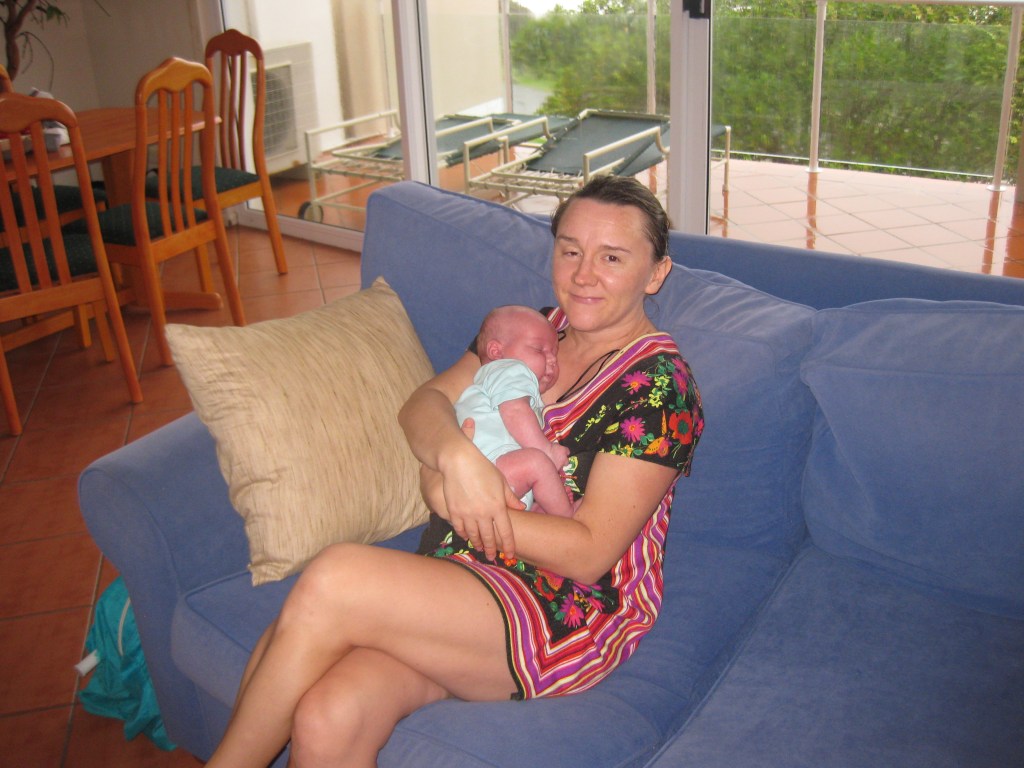
The positives are that in the wake of the talk and comments about it, women who have survived ppp have felt safe enough to post about their experiences.  They look into the camera, cradling their babies, like a million other new mothers on social media. In doing so they show ppp has many different faces, that it can happen to anyone, and that it is possible to look normal while your thoughts are lying to you.  

Plenty of women who have experienced perinatal depression (pnd) and perinatal anxiety (pna) are also voicing their stories of being trapped in the dark, airless corners of motherhood.

Many have fallen through the cracks of a mental health system too.

They say: ‘That could have been me.’

Yet, invariably every ‘That could have been me’ is followed by a powerful caveat: ‘Except for the outcome’, which means ‘That could never be me.’ 

The incidence, degree of stigma around, and treatment of pnd and pna and ppp is different and conflating them is misleading.

All of these conditions carry a risk of suicide, but the risk of infanticide due to pnd alone is so low it lacks a statistical percentage. For women who experience ppp the risk of infanticide is about 4% if left untreated.

In the context of this court case any woman with lived experience of a perinatal mood disorder has earned the right to step into this discourse or to give it a wide berth.

Beyond lived experience posts and a handful of reputable professional sources, it mostly feels like a circus out there.

Content creators are virtually camping outside that court room in America and are creating a freak show to slaver over, greedy to extract every salacious morsel they can out of a broken woman’s agony.

There are posts from alleged mental health professionals doing a to camera piece on how scary it is to be in a room with a patient with ppp, centring the experience solely on them.

Psychiatrists, other medical professionals, and lawyers pick over the bones of this case, and a woman’s sanity on Instagram. It may be well intentioned, but it is also for the entertainment of their followers.

There are lawyers, nurses, and content creators dressed for a picnic or book club meeting, sometimes including a pet, with a glass of red wine or an iced latte in hand giving us their hot take on this case and the people involved.

They remind me of the women knitting by the guillotine during the French Revolution.

I have been diving in and out of comment sections in the last few days.  My exchanges have generally been respectful. They have also thrown up interesting questions. Sharing my thoughts on one iced coffee wielding content creator’s page prompted them to ask me ‘Would you rather we didn’t talk about it at all?’

It is a double-edged sword. Yes, it needs to be discussed. But is all publicity good publicity? 

I responded by asking how they would feel if only the worst one-dimensional views about their demographic were being picked over and posted by people who had not lived it?

The years of writing about my experience of early detection and appropriate treatment of ppp, of surviving with my family intact feel like I have been shouting myself hoarse into a widening void.

Survival is boring. Having happy, healthy adult and nearly adult children is boring. Not facing life imprisonment is boring. Good outcomes are not click bait.

And yet for women who have experienced ppp, or who are experiencing it, the most important thing for them to know is not that this condition could end their lives, their children’s lives, that their experience could end up being torn apart by vultures on social media, but that devastating outcomes are not a foregone conclusion of postpartum psychosis.

The most important thing for them to know is that there is hope.

Below is a sample of some of the other writing and speaking I have done about postnatal psychosis:

Guilty Of Postnatal Psychosis

Media-Made Monsters

https://www.abc.net.au/listen/programs/conversations/conversations-anita-link-rpt/9009148

Surviving On Snippets Of Hope

I know people who don’t consume the news anymore. Others avidly click, swipe, and share and demand the shares be shared and that donations be made.

A sense of needing to ‘do something’ beats like a heart behind our screens.

Some say the carnage and its causes are complex. Others claim it couldn’t be simpler. Meanwhile, powerful, malevolent toddlers masquerading as leaders extinguish lives with their belligerent tantrums. This kind of hellish tit for tat has been going on all over the planet for aeons. There’s nothing new about our news.

The atrocities we were clicking and swiping and enthusiastically sharing and donating to a year or two ago, are far from over.  This trauma has not stopped. It’s just not as fresh as what we are fed from further south right now.

While my bipolar disorder sleeps, I choose to neither soak myself in headlines nor bury my head in our (increasingly hot) sand.

I have always struggled to understand warring over a homeland, because (regardless of my genetics, birthplace, or heritage) I don’t identify as belonging to a country or a people. I was taught to be a chameleon, a grateful visitor wherever I go. It has been drilled into the DNA of my family who moved around a lot, who has flight in its history, whose ancestors have done their best not to be in the wrong place at the wrong time.

I don’t believe humanity has quite enough humanity to ever achieve world peace. If we had the capacity to resolve conflict without collateral civilian casualties, we’d have done so a long time ago.

Our individual lack of control over global catastrophes and atrocities can feel depressing. But we can each control how we react to our feelings. Providing we are not experiencing a severe episode of clinical depression, we can feed our sense of hope by turning a microscope on our own lives and surroundings.

Good stories play out near us all the time. I witnessed one on holidays at the beach recently:

A not so gentle day. Dumping waves boiled the water. One after the other. If you got caught up in one of those you became an ingredient in a soup of flailing limbs. A bit closer to the shore we laughed and played in the sea foam bubble bath, eyes always on the incoming, legs resisting the drag out into the angry ocean.

Then to my right a little girl, five or six, began to cry. The wash after a wave swallowed her and spat her back up like an acorn. Spluttering, she looked wildly about. I assumed the woman near her was her grandmother. She scooped up the crying girl and pointed to some other adults nearby. The girl shook her head, sobbed red faced, hair plastered to her head.  I just caught the older woman’s words above the rush of water.

‘Can you point to your mummy or daddy darling?’

The girl was crying too hard for speech, too hard to point. This was not her grandmother.

Yet she positioned the girl on one wide hip and purposefully strode away from danger. Finally, where the waves petered out onto the sand, the girl’s father appeared, and a narrative that could have played out so badly, ended well.

While the brutality of the news can suck the happiness out of our heads, good things still exist. And they don’t need to be stories. Simple snippets suffice:

Taking refuge from a storm in a second hand book shop.

 Sleeping cats.

A tidy bedroom and a good book.

The sound of cicadas.

Wildlife visitors.

Converting ingredients into a meal.

Having a kitchen to cook in.

A warm hand to hold walking in the summer breeze.

A rainbow, thunder, and lightning occupying the sky all at once.

The clink of ice cubes against a condensation beaded glass, and the first sip.

Clean pyjamas after an evening shower.

Children growing into themselves.

Free will and choice…

When I disengage from my screens for long enough to look around me, snippets appear everywhere.

I have at times been guilty of outrage in response to what my screens feed me.

But, for me, outrage on its own achieves little. It is hot air shouted into a furnace. And it is a luxury I can’t afford or sustain, because ongoing outrage can convert into powerful fuel for a bipolar episode.

On the other hand, deciding to tend the happiness in my own backyard builds the strength to do meaningful things for myself and the wider world.

PS: If you are clinically mentally unwell, then the suggestions in this post to focus on the positives around you apply only if you are well enough to do so. Symptoms of severe mental illness, especially clinical depression, can make it impossible to focus on the positives without more targeted treatments, such as psychological or medical therapies.

For me, a sign that I need more support than the power of positive thought is when I find it impossible to focus on the positive, and guilt and negative self-talk set in, because I’ve failed to appreciate the positive.

Lastly, if I were currently experiencing a bipolar episode I would not consume any news, and would focus solely on recovery.

You may also like:

Gentle Shoots Of Hope

Deciding To Hope

Gentle Shoots Of Hope

I entered this year softly. Sparkling into it from one minute to the next, without expectation. But finding joy on the other side of the second hand.

I could now spend a paragraph on the 2020/2021 disclaimer for happiness, the guilty acknowledgement of everyone who may be suffering, that feels as though it has become mandatory whenever you write or talk about anything remotely good happening to you in pandemic times.

But I won’t, because in this moment it feels disingenuous. The events of the last couple of years may have thrown it into sharper relief, but virus or not there have always been people who have it worse than me and those who have it better.

So – no disclaimers. We’ve all had challenges from the dung heap of life thrown at us. I don’t believe bad things happen for a reason. But I do believe that it is the rubbish times that make magic moments shine when we happen upon them.

I spent New Year’s Eve last year (2020/2021) in hospital – just one day in a holiday package that started with an admission on Boxing Day. I didn’t feel well enough for people. Including my husband and children. Dinner came with a serve of ‘seasonal vegetables’ leached of colour and boiled into malodourous oblivion. Dessert was my nightly mouthful of dry medications washed down with tepid water. Long before midnight I was obliterated by that medication and happy to be so. Joy was not part of the equation.

When it came to thinking about New Year’s Eve plans for last year, I had only recently discharged from hospital after another Bipolar flare. A brief 3 week admission starting in late October that bled well into November.

I juggled the idea of having friends join us for what is a special evening for me.

From the ages of six to thirteen I grew up in Germany, in a culture that celebrates New Year’s Eve joyfully and raucously. I remember towers of champagne glasses filled and overflowing with bubbles from the top tier down. There was music and animated conversation, which gave way to the fireworks at midnight. People bought their fireworks from the supermarket and let them rip into the newborn year from their snowy backyards.

On New Year’s Eve 2000 I introduced my (then new) husband Michael to this way of celebrating. We were living in the UK, but had travelled back to Germany for the holidays. We spent that New Year’s Eve with Sandra, one of my closest friends, and Thomas – her partner, and their friends. We had raclette, lots of drinks, and laughed so hard. Just before midnight, we climbed into our coats, boots, hats, scarves, and gloves and walked, stumbling ever so slightly, down to the beautiful lake Sandra and I had spent childhood summers swimming in and childhood winters ice skating on. It was freezing. Too cold to feel our faces. The whole village was there. The air smelt of nothing but fireworks. We were in our twenties and euphoric.

Thomas died barely six weeks ago. The loss of someone we loved has been compounded for me because I can’t hug his wife – my lifelong friend whose hand I used to hold as we jumped into a New Year.

New Year’s Eve in Australia is different. It is the hot afterthought to a showy Christmas. The vibe around New Years for many Australians is ‘Meh – can’t be bothered.’ or it’s a night of heavy drinking that culminates in a headache on New Year’s morning and a set of resolutions, which won’t last past January.

And yet I celebrate the ending and beginning of years…when I can. In part it is fuelled by nostalgia. It is also because I have learnt to celebrate things while I can, because there will be times when I have no choice whether I get to celebrate or not. There are times when I am too unwell. Times when it’s overboiled vegetables instead of home cooking.

Not celebrating can also be a missed opportunity for making memories. Memories of joyous hours, which become part of everyone’s narrative. Memories that become unspeakably precious in hindsight when we have lost those we shared them with.

And so, I sent out some invitations and had a beautiful night.

There were candles and sparklers and laughter across an increasingly messy tablecloth as the night moved on. We ate pistachio baclava with mint and rosewater syrup and white peach sorbet for dessert.

By 2 am the house was buzzing. I had picked up my older child and two of their friends from another party to join the other couple of kids already at home for a sleepover. In the early hours of this New Year my house was steeped in happiness.

For me, 2022 has started with love and energy, and out of the losses and difficulties of the previous year I sense gentle shoots of hope are emerging.

One of the positives of 2021 was that my memoir Abductions From My Beautiful Life was published. For an excerpt and more info click here Book

You may like to check out how some of my other years have gone in these posts:

2020 Ends In Hospital

Covid Lockdown In A Psychiatric Hospital

2018 – The Year I:

Deciding To Hope

To hope or not to hope?

In one week my immediate family and I are leaving for a holiday on Heron Island. That was a difficult sentence to commit to. Not the sentence, just one word.

‘Are’

The certainty inherent in those three letters. Articulating it feels like I am going to jinx it, like I will alter the course of history, even though I know that’s impossible.

This is our third attempt at this holiday. The first was over Easter 2021. I almost needn’t follow that up with any explanation. To use a recently much reworked cliché -everyone was in the same boat…or in our case not in the boat bound for our holiday destination.

It was a time of global holiday cancellations. We were all still invigorated by the adrenaline of the early days of a pandemic many believed could be conquered and left behind.

We rebooked our holiday for Easter this year. But in a twist of acutely painful timing our city was locked down. Ironically only for 3 days. But they were the exact 3 days we were meant to travel to Heron Island.

By the time that little lockdown ended, everyone else was off to enjoy their Easter camping trips. We were left feeling slapped, as though we had been singled out by the universe to miss out on our holiday.

But we rebooked again. For next week. Knowing it might not eventuate this time either.

And about three weeks ago doom crept into the family. We began to censor ourselves and each other. Snapping ‘If it happens!’ if anyone dared mention anything to do with the holiday. We shot each other down with sarcasm and repressed feelings as though expressing any plans, hope or joy associated with this holiday would save us the disappointment if it had to be cancelled again.

So, just under three weeks ago our family decided – that instead of clenching everything, and white knuckling it through this will-we-wont-we time, we would allow ourselves to feel the joyful anticipation of this holiday.

We began to talk about what snacks we’d take on the car trip. What we were looking forward to most. We wondered if we would see clown fish. We started making packing lists.

Don’t misunderstand me. This is not about mindlessly Pollyanna-ing the reality we live in. All four of us are abundantly aware that things can look like they are going ahead one day only to have them snatched away in a minute.

While it is true that right now we have no control over whether our holidays or special events will be cancelled at the last minute – it is also true that we never did, we just weren’t as acutely aware of it.

But we can choose how we feel in the lead up to planned events. We can choose to anticipate disappointment or anticipate joy. Whether it ends up being disappointment or joy is almost irrelevant because it isn’t about the eventual outcome. It is about how we feel right now.

We can choose to scrunch ourselves into a ball of anxious negativity. But for what? Being able to say ‘See I told you it would be cancelled’ if it is cancelled? Like a sort of sick Schadenfreude directed at ourselves.

Or we can choose a more relaxed, positive attitude that coexists with the knowledge that it may be cancelled, but that the anticipation is pleasant. If the holiday goes ahead we will have had a much nicer lead up to it, than having to spend the first few days unclenching from the negativity.

If it doesn’t happen, we’ll be disappointed, but we won’t have wrecked the preceding few weeks with dread.

Choosing to have low expectations in an attempt to avoid disappointment is not only flawed, but in these times of immense uncertainty it doesn’t serve us well. It robs us of joy. The brave thing to do is hope in the face of uncertainty regardless of whether that hope ever grows into reality.

That said, I have two disclaimers for the hope approach.

The first is that the ability to conjure hope relies on reasonable mental health. Someone experiencing symptoms of mental illness, especially those featuring depression or anxiety will no more be able to think themselves into hope than a diabetic can think their blood glucose levels into the correct range. They will need the right treatment for them before hope can become a choice again.

The second is that if you are attempting this with children, they need to be old enough/emotionally mature enough to understand that the hope does not guarantee the holiday.

For today, everyone in my family is well enough to hope that by mid next week we will get to see those clown fish and soak in the endless blues of the sky and the ocean surrounding our tiny Island destination.

You may also like to check out:

On Uncertainty

Covid Year 2: Timing Your Perspective

Razor Blades In Mud: Laziness Or Depression?