Mental Illness Doesn’t Respect Deadlines

20190729_064126
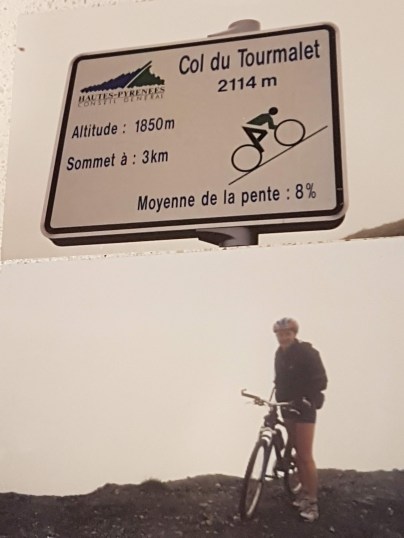
September 2001 – Ascending the Col du Tourmalet

‘How long until I’m better?’ gnaws at my insides.

When I ask my psychiatrist that question, he always answers honestly:

‘I don’t know how long, but you will get you better.’

That ‘I don’t know’ even when it’s followed by a promise of eventual wellness, is brutal.

Many years ago, my husband and I took part in a cycling trip over the Pyrenees from the south of France into Spain. The route followed the same path as the Tour de France sometimes does. The first day took us up the Col du Tourmalet, one of the longest and steepest climbs. We rode around twenty kilometres to the base of the mountain and then climbed for close to another twenty, each one steeper than the last, the air getting thinner and thinner.

The last two kilometres were gruelling. Mist closed in. We could barely see the drop off the edge of the mountain. We rode on our lowest gears. Our bones turned into burning jelly and our lungs felt as though they were trying to extract oxygen from water. We were forced to stop to catch our breath every twenty or thirty metres.

But there were markers to show us we were getting closer to the top. Mental footholds in the misty, painful, breathless soup. We had answers to ‘How much longer?’. And with them came hope and the tenacity to keep going. Although it was unbelievably challenging, we had an end point to work towards.


Continue reading “Mental Illness Doesn’t Respect Deadlines”

My Mental Health Toolbox

PWC keynote image

This week I had the pleasure of giving a keynote address for one of the departments at PWC (Price Waterhouse Coopers). As part of this I ran through some of the things I have found helpful to help me monitor and manage my mental health.

I got some really positive feedback after the presentation and requests for the list of things that help me with my mental health. So I thought I’d share that list as a post here:

EARLY WARNING SIGNS AND INSIGHT:

In this context insight is the ability to identify early signs of mental ill health in yourself. This is much more challenging than it sounds, because signs of mental illness can masquerade as normal feelings and emotions.

For example – irritability and sadness are part of the normal spectrum of human emotions, but if they are overwhelming and persistent and interfere with normal functioning, they can also be symptoms of depression.

It can take time to identify their intensity or persistence as abnormal. The other challenge is that when we are well, we can often think our way out of sadness or irritability. But when they become symptoms that is impossible.

Someone affected by symptoms of a mental illness can no more think their way out of them than someone with a nasty case of gastro can think themselves out of their vomiting and diarrhoea.

But whereas vomiting and diarrhoea are obvious signs of illness (both to the person experiencing them and everyone around them) it takes insight to recognise when symptoms of mental illness emerge.

For me early warning signs can be an inability to sleep even with a lot of medication, intense irritability, and poor short-term memory and concentration.

Early warning signs are different for everyone. By learning what ours are we can be proactive about seeking help rather than waiting for symptoms to worsen.

For further reading on an example of insight into a depressive episode you can go to: Razor Blades In Mud: Laziness Or Depression?

Continue reading “My Mental Health Toolbox”

What a mental illness can teach you about your mental health

jony-ariadi-197568-unsplash Photo by Jony Ariadi on Unsplash
Photo by Jony Ariadi on Unsplash

Here’s a paradox: My mental health improved after I developed a mental illness. When I am not symptomatic (which is a lot of the time) my mental health is fantastic. It is possibly better than that of many people who don’t live with a mental illness. Here’s why:

Mental illness can teach you a lot about mental health, because it confronts you with the choice to change the way you approach your life.

Continue reading “What a mental illness can teach you about your mental health”

Psychology Of A Rescue

lifebelt-4148444_1280

Have you ever tried rescuing someone who doesn’t want to be rescued?

There’s the itchy frustration of being able to see they need help. You do everything in your power to help them, but they want none of it.

We had the following teachable situation take place in our household recently:

My daughter loves birds and started feeding the sulphur crested cockatoos in our garden. Word of the new food source got around. Each day more arrived. One morning the cohort included a scruffy straggler. He was bullied by the others. His point of difference was a plastic cone around his neck, almost identical to the Elizabethan collars we put on dogs and cats to prevent them chewing out their stitches.

But this was a school sports marker. The cockatoo had poked its head through it. I assume out of curiosity or to get to food in the middle of it. And now it was stuck. It could still eat, but not well. We thought hard about how we could help this bird. I suspected removing the cone wouldn’t be difficult if we could only catch it.

It flew off as soon as we got anywhere near it. My daughter phoned Australia Zoo who referred her to a wildlife organisation, who referred us to the RSPCA. I explained the dilemma and sent pictures of the cone headed bird. The RSPCA delivered a large metal dog crate and we rigged the door with string, so that we could close it remotely.

Continue reading “Psychology Of A Rescue”

Accepted: Crumbs To Canary Wharf

20190419_210616

It started on the paper bag that the breakfast toast came in. First, I shook out the crumbs to give me an even writing surface. I had no other paper. I was inside the SCU (Special Care Unit), in a psychiatric hospital in August 2006, emerging from my first psychotic episode. And as the medication slowed my boiling brain, a miniscule part of me, took in my environment and thought:

‘I am one step away from a padded cell. Unbelievable. But while I am here, I will record as much as I can, because not many people experience this.’

So, I made my words tiny to fit as much detail as I could onto the toast bag.

Over a year later I wrote an account of my psychotic episode based on that bag and some diary entries. My supervisor for my Master of Arts in Writing Editing and Publishing read it.

‘This is really good writing. You should consider expanding it into a memoir.’

Continue reading “Accepted: Crumbs To Canary Wharf”

Bruised

20111130-171621

In the beginning I struggled to accurately identify the source of my discomfort. First, I felt cranky. Then defensive. Sentences coiled through my head, arguing my case to non-existent judges.

And then the fantasy started:

The sanctity of an operating theatre. Me doing surgery. A space where competence is nonnegotiable and where logic rules supreme. A space where superfluous emotion is rinsed off in the scrub sink. The flat mineral smell of iodine, hands held up, so drips go down. The linearity of actions. Being handed packets – the hand towel, the gown and gloves, instruments. All sterile. A clean slate for this one patient, this one surgery. The fantasy is not about wanting to re-enter veterinary practice. It is about control. The thought of having that degree of control over a situation makes me shiver with longing right now.

Continue reading “Bruised”

Your Mental Load = Your Responsibility

20190328_184140

Have you heard of ‘the mental load’ (also known as emotional labour)?

The term is bouncing about everywhere right now. Google it if you like, but this is my understanding of it:

The mental load is carried (predominantly) by women. It comprises the things that (they believe) are essential to the welfare of their relationship or family, for example meal planning, remembering relatives’ birthdays, or buying toothpaste before it runs out. The carrier of the mental load often feels overwhelmed or resentful because their partners don’t share it.

Now, I am all for the equitable distribution of work, including paid employment, childcare, chores, and general life admin. However, my sympathy for people who complain about their ‘mental load’ nose dives when I hear or read this:

‘My partner should know what to do without me having to ask them. Me having to ask adds to my mental load.’

Continue reading “Your Mental Load = Your Responsibility”

Who Holds You When You’re Broken?

20170702_192834

I’ve been told the first time we met I was shuffling slowly up and down a blue carpeted corridor. Slumped body. Empty eyes. I barely registered being asked how I was with a slowly exhaled

‘Not so good.’ before moving on with my pram.

I say ‘I’ve been told’, because I don’t remember our first meeting or the following weeks. I was sicker than I’d ever been. Not many people would have repeatedly made friendly conversation with someone as unresponsive as I was.

She did. At a time when she wasn’t well herself.

When I finally re-emerged after several months of illness, I was delighted to find I had a new friend. A friend I never would have met in my geographical or professional circles. A friend who, like me, had spent the early months of first-time motherhood in a psychiatric hospital instead of at home.

Continue reading “Who Holds You When You’re Broken?”

My Mental Illness Makes Me A Better Parent

20181215_155709

I am giving my eight-week-old son a bath. One hand supports his head and neck, the other gently moves a wash cloth over his delicate skin. He kicks his legs, rippling the shallow water. His dark eyes stare up at me. Pools of trust. I make a minute adjustment to my hand supporting his neck. His head slips under the water, for less than a second before I instinctively lift him up. He splutters briefly and is fine. But I am not.

I hit the call button next to the baby bath and a nurse pops her head in:

‘Are you ok?’

‘No.’

I hand her my baby. Nausea clamps my stomach and works its way up my throat. Black mist hovers in my peripheral vision and I sink to the ground. I put my head between my knees, as red-hot malignant words shoot through me:

‘Did I just try to drown my baby?’

Continue reading “My Mental Illness Makes Me A Better Parent”

Our Vets Are Dying For Your Pets

Image result for veterinary euthanasia images
Image courtesy of Cascade Veterinary Hospital

Contains Confronting Content

I recently removed the key to the dangerous drugs safe in the veterinary practice I’ve just resigned from, from my key ring to return it. And as I did so, I thought:

‘I wonder if my suicidal ideations will change now?’

I’ll come back to that.

I also recalled how often I’d heard the following over the last twenty years in practice:

‘My son/daughter/nephew wants to be a vet when they grow up.’

Always uttered under the impression that veterinary work is a dream job. But the dream can morph into a nightmare. There is currently a shortage of vets (in part) because our burn out and suicide rates are sky-high.

So why, after dedicating years to entering this prized profession, do many vets want out?

Continue reading “Our Vets Are Dying For Your Pets”